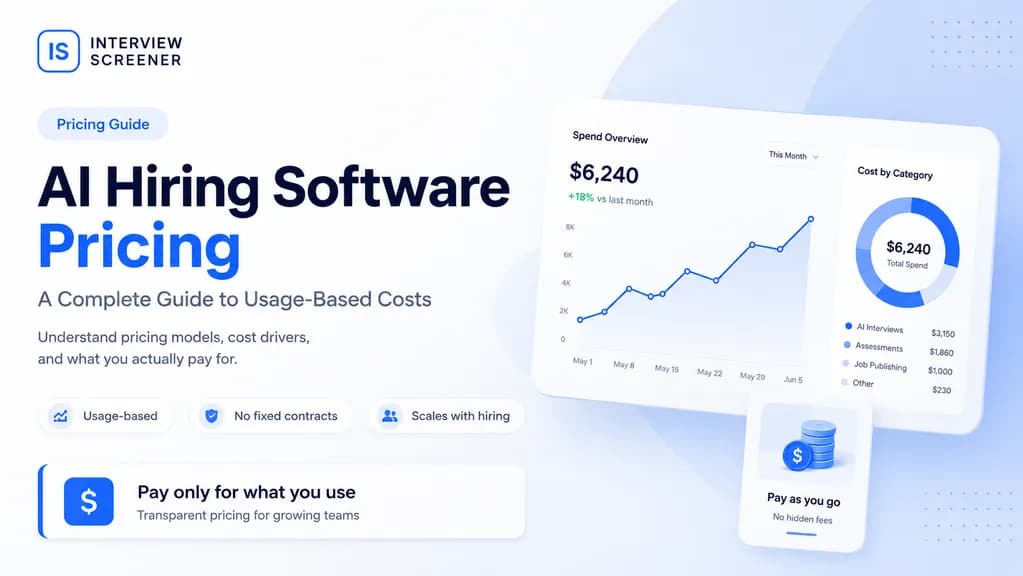
AI Hiring Software Pricing: A Complete Guide to Usage-Based Costs
Most AI hiring tools hide their real cost behind "contact sales" buttons and annual contracts. That makes budgeting hard and locks small teams into fees they may not use. Understanding pricing models fixes this.
This guide breaks down how AI hiring software is priced, what drives cost, and how to compare options. It is written for recruiters, HR leaders, and founders evaluating recruitment automation budgets.
What Are the Main AI Hiring Software Pricing Models?
AI hiring platforms use three dominant pricing structures. Each suits a different team size and hiring volume.
The three models are:
- Usage-based — you pay per action, such as per resume screened or per interview minute.
- Per-seat (subscription) — you pay a fixed monthly or annual fee for each recruiter seat.
- Enterprise contracts — custom, negotiated annual pricing, often with volume minimums.
The right model depends less on price-per-unit and more on how consistently you hire throughout the year.
Why Pricing Model Matters More Than Sticker Price
A low per-seat fee looks cheap until you hire only occasionally. Then you pay for months of idle access. A usage-based tool that charges more per action can cost far less overall for irregular hiring.
Match the model to your hiring rhythm, not just the headline number.
How Does Usage-Based AI Recruiting Software Pricing Work?
Usage-based pricing charges you only for what you consume. There is no fixed monthly commitment. You add credit or pay as you go.
Costs typically break into two components:
- Resume screening — a small fee per CV parsed, scored, and ranked.
- AI interviews — a per-minute fee based on the voice engine and AI model used.
This means a month with no hiring costs nothing. A month with heavy hiring scales up proportionally.
What Drives the Per-Minute Interview Cost
Interview cost varies with the technology chosen. Key cost drivers include:
- Voice engine — premium voices (such as ElevenLabs) cost more than standard ones.
- AI model — advanced LLMs (such as GPT-5 or Claude 4.5) cost more than lighter models.
- Interview length — longer interviews consume more minutes.
- Language — some premium voices for specific languages carry higher rates.
You control cost by matching the engine and model to the role's importance.
<strong style="background-color: transparent;"><img src="https://interview-screener.s3.us-east-2.amazonaws.com/article-body-images/a57d3230-62af-4a8e-ab2a-f7c2e917378f.webp" alt="What Does AI Hiring Software Typically Cost?"></strong>
A Simple Cost Example
Imagine screening 400 resumes and interviewing the top 40 for 10 minutes each:
- Screening: 400 resumes × a few cents = a modest flat cost.
- Interviews: 40 candidates × 10 minutes × per-minute rate = the bulk of the spend.
Under usage-based pricing, you pay this once — then nothing until your next hire.
<strong style="background-color: transparent;"><img src="https://interview-screener.s3.us-east-2.amazonaws.com/article-body-images/683c44b4-b006-48e9-85d6-2f6696218156.webp" alt="Usage-Based vs. Per-Seat vs. Enterprise: Which Is Cheapest?"></strong>
Why Choose Usage-Based AI Hiring Software?
Usage-based pricing aligns cost with value. You pay when you hire, not when you don't. This appeals to teams with unpredictable needs.
Key advantages include:
- No wasted spend. Idle months cost nothing.
- No contracts. Start and stop freely, with no lock-in.
- Transparent costs. You see exactly what each hire costs.
- Low entry barrier. No large upfront commitment to begin.
- Scales naturally. Cost rises and falls with actual hiring volume.
Who Benefits Most
Usage-based pricing fits startups, seasonal employers, agencies with fluctuating client demand, and any team whose hiring comes in bursts rather than a steady stream.
Teams that hire at a constant, predictable rate may still prefer a flat per-seat fee for budgeting simplicity.
What Hidden Costs Should You Watch For?
Sticker price rarely tells the whole story. Before committing, check for these common hidden charges:
- Per-user fees stacked on top of a base subscription.
- Integration costs for connecting your ATS or careers page.
- Overage charges when you exceed a plan's included volume.
- Annual lock-in that prevents cancellation mid-term.
- Premium feature gating where AI interviews or multilingual support cost extra.
Questions to Ask a Vendor
Before buying, ask:
- Is pricing per action, per seat, or contract-based?
- What exactly is included versus billed separately?
- Are there minimums, overages, or cancellation penalties?
- Do AI interviews and multilingual support cost extra?
- Can I start without an annual commitment?
Clear answers signal transparent pricing. Evasive ones signal hidden cost.
How Do You Estimate Your AI Hiring Budget?
Estimating cost is straightforward with a usage-based model. Follow this process:
- Estimate applicant volume. How many resumes per role, per month?
- Estimate interview volume. How many candidates advance to AI interviews?
- Set interview length. Average minutes per interview.
- Apply per-unit rates. Multiply by the screening and per-minute costs.
- Add a buffer. Account for hiring spikes.
Many providers offer a pricing calculator to automate this. Use it to model best-case and worst-case months before committing.
Frequently Asked Questions
How much does AI hiring software cost?
Costs vary by model. Usage-based platforms charge a few cents per resume screened and from a few cents to a few dollars per interview minute, depending on the voice engine and AI model. Per-seat tools charge a fixed monthly fee per recruiter, regardless of hiring volume.
What is usage-based AI recruiting software <a href="https://interviewscreener.com/pricing" rel="noopener noreferrer" target="_blank" style="background-color: transparent;">pricing</a>?
Usage-based pricing charges you only for what you use — typically per resume screened and per interview minute. There is no fixed monthly fee or contract. Months with no hiring cost nothing, and costs scale up naturally during heavy hiring periods.
Is usage-based pricing cheaper than a subscription?
It depends on hiring frequency. For irregular or seasonal hiring, usage-based is usually cheaper because idle months cost nothing. For steady, constant hiring, a fixed per-seat subscription may offer better predictability and lower per-unit cost at high volume.
Are there hidden costs in AI hiring software?
Sometimes. Watch for per-user fees, integration charges, overage fees, annual lock-in, and premium features like AI interviews or multilingual support billed separately. Always ask a vendor exactly what is included versus billed as an add-on before committing.
Can I use <a href="https://interviewscreener.com/" rel="noopener noreferrer" target="_blank" style="background-color: transparent;">AI hiring software</a> without a contract?
Yes. Usage-based platforms typically require no contract or annual commitment. You pay as you go, add credit as needed, and stop anytime. This makes them ideal for startups and teams with unpredictable hiring needs.
AI hiring software pricing does not have to be opaque. Once you understand the three models, matching cost to your hiring rhythm becomes simple. For most growing teams, usage-based pricing offers the best balance of transparency, flexibility, and value — you pay for hiring only when you actually hire.
Want to see your exact cost? Try the pricing calculator and get transparent, usage-based AI hiring — no contracts, no hidden fees.